The Numbers Behind Growth: Why Accurate Financial Information Becomes Non-Negotiable for Landscaping Companies Scaling from $2 Million to $10 Million

By Michael Jamison, CPA, CGMA One of the biggest differences I see between landscaping companies that successfully scale from $2 million to $10 million in revenue and those that plateau is not sales ability, production expertise, or even leadership talent. It’s financial visibility. At $2 million, many companies can survive on instinct. The owner […]
The Owner Cannot Be the Growth Strategy: How Fractional Support Helps Home Services Companies Scale Without Burning Out
By Michael Jamison, CPA, CGMA Many home services businesses do not stop growing because the market is too small. They stop growing because the owner runs out of capacity. That is an important difference. A strong HVAC, plumbing, electrical, roofing, landscaping, restoration, or pest control company may have plenty of opportunity in front of […]
The $50 Million Decision: Why Home Services Owners Should Think Carefully Before Selling Too Soon

By Michael Jamison, CPA, CGMA One of the most important decisions a successful home services business owner will ever make is not whether they can sell the business. It is whether they should sell it now. That distinction matters. Across HVAC, plumbing, electrical, roofing, landscaping, restoration, pest control, and other home services industries, […]
You Got an IRS Letter – Now What? A Step-by-Step Guide for Indianapolis Business Owners
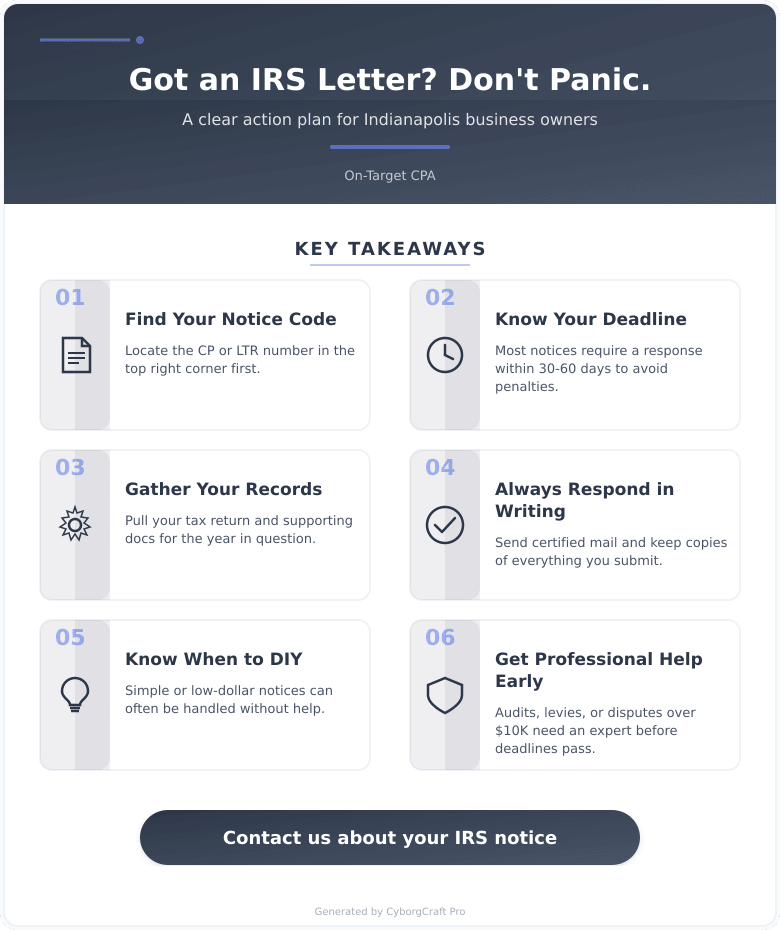
Getting an IRS letter as a business owner triggers immediate stress – but most notices are manageable when you know how to read them and respond correctly. Every IRS notice carries a CP or LTR code in the upper right corner that tells you exactly what the agency wants, whether that is a missing return, a balance due, a discrepancy in reported income, or a more urgent collection warning. The biggest mistake business owners make is ignoring the notice and hoping it goes away – it never does, and the consequences compound quickly. This post walks through a clear six-step response process: identify the notice code, note the deadline, gather supporting tax records, determine whether you agree or disagree with the IRS finding, respond in writing via certified mail, and track your case until resolved. A comparison of notice types – from simple CP14 balance due notices to serious LT11 levy warnings – helps readers quickly gauge the urgency of their situation. The post also covers when handling a notice independently makes sense versus when bringing in a CPA is the smarter move, particularly for CP2000 underreporter notices, audits, or multi-year issues. Indianapolis business owners will find specific guidance on common mistakes, required documents to gather before responding, and what 2025 IRS enforcement activity means for response timelines. On-Target CPA, located in Indianapolis, Indiana, helps business owners navigate IRS correspondence with a structured, documented approach that protects their interests from the first response forward.
The Most Important Succession Planning Change for Main Street Business Owners in Years

By Michael Jamison, CPA, CGMA For years, I have had the same frustrating conversation with successful business owners. They spent decades building a company. They created jobs. They developed leaders. They built a culture that mattered. When the time came to think about succession, their first choice was often clear: sell the business to […]
Offer in Compromise: The IRS Program That Can Settle Your Tax Debt for Less Than You Owe
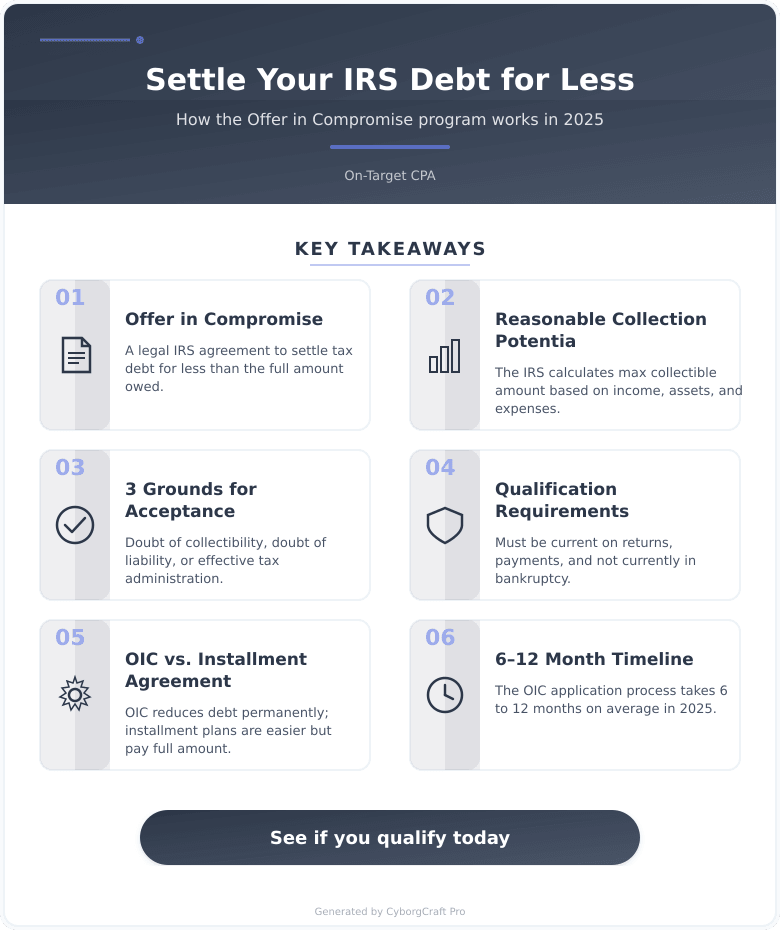
An Offer in Compromise is one of the few IRS programs that actually allows taxpayers to settle federal tax debt for less than the full amount owed. The key is understanding that the IRS accepts these offers based on a precise financial formula – your Reasonable Collection Potential – not simply because you are struggling. This post breaks down exactly how the program works in 2025, the three grounds for acceptance, and how an Offer in Compromise compares to alternatives like installment agreements and Currently Not Collectible status. Indiana taxpayers face state-specific IRS expense standards that affect how the agency calculates what you can pay, and those local numbers matter. The post walks through a complete seven-step action plan, a document checklist for applicants, and the most common mistakes that lead to rejection. A dedicated FAQ section covers costs (the 2025 application fee is $205), timelines (6 to 12 months), the appeal process, self-employment complications, and how Indiana’s own state tax settlement program operates separately from the federal one. The content is designed to help readers quickly assess whether they might qualify and what concrete steps to take next.
The Bookkeeping Mistakes That Cost Small Businesses Thousands Every Year (And How to Stop Making Them)
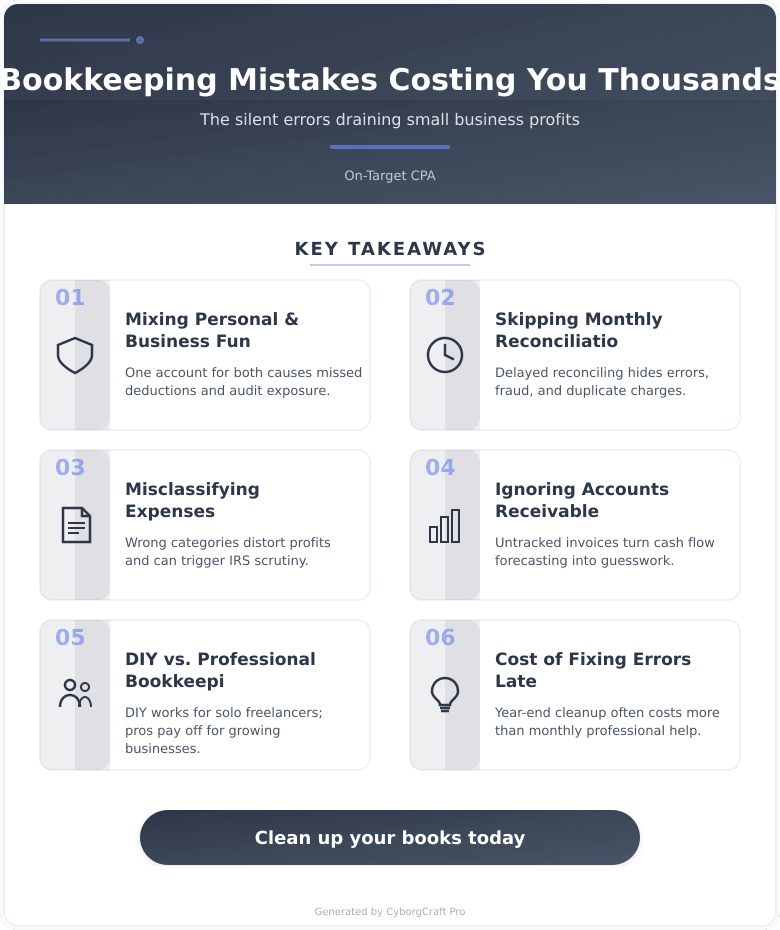
Small business bookkeeping mistakes are far more expensive than most owners realize, and they rarely announce themselves until tax season or a cash flow crisis. The most damaging errors include mixing personal and business finances, skipping monthly bank reconciliation, misclassifying expenses, and ignoring accounts receivable. Each of these problems distorts financial reports, inflates tax liability, and creates IRS audit exposure. For Indianapolis-area businesses in 2025, Indiana’s updated flat income tax rate makes accurate income tracking especially valuable for pass-through entity owners. The post compares DIY bookkeeping against professional services with a cost table showing 2025 market rates, and delivers a five-step action plan covering account separation, monthly reconciliation, proper chart-of-accounts setup, AR tracking, and monthly financial reviews. A preparation checklist outlines exactly what business owners should gather before their first bookkeeping review. The FAQ section covers audit risk, reconciliation frequency, cost benchmarks, and the difference between bookkeeping and accounting. The core message is clear: professional bookkeeping typically costs less than the mistakes it prevents, and clean books are the foundation of every smart financial decision a business owner makes.
Buying a Business in Indianapolis? Here’s What Your CPA Needs to Review Before You Sign Anything
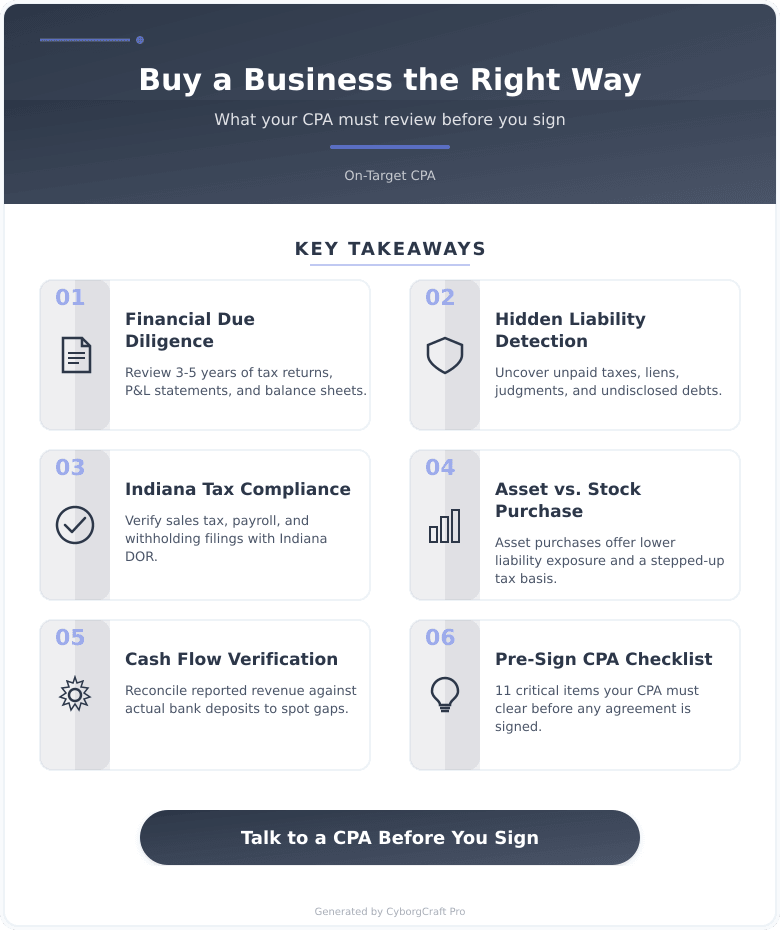
Buying a business without a proper CPA review is one of the most common and costly mistakes Indianapolis buyers make. This post breaks down exactly what a pre-acquisition financial review should cover, from reconciling tax returns and P&L statements to obtaining Indiana Department of Revenue tax clearance certificates that protect buyers from successor liability. The asset purchase vs. stock purchase comparison shows why deal structure matters for long-term tax exposure, with a clear recommendation for most small business deals. Indiana-specific issues get direct attention, including the state’s pass-through entity tax election changes in 2025 and how neighboring states like Ohio, Illinois, Michigan, and Kentucky compare on clearance processes and risk. A full step-by-step action plan gives buyers a practical roadmap, and the six-question FAQ section covers costs, timelines, liability rules, and earnings recasting in plain terms. The post positions the CPA as a critical pre-signing partner rather than an afterthought, with two soft CTAs and a strong closing call-to-action directing readers to On-Target CPA in Indianapolis.
The Real Cost of Filing Your Business Taxes Late – And What You Can Actually Do About It
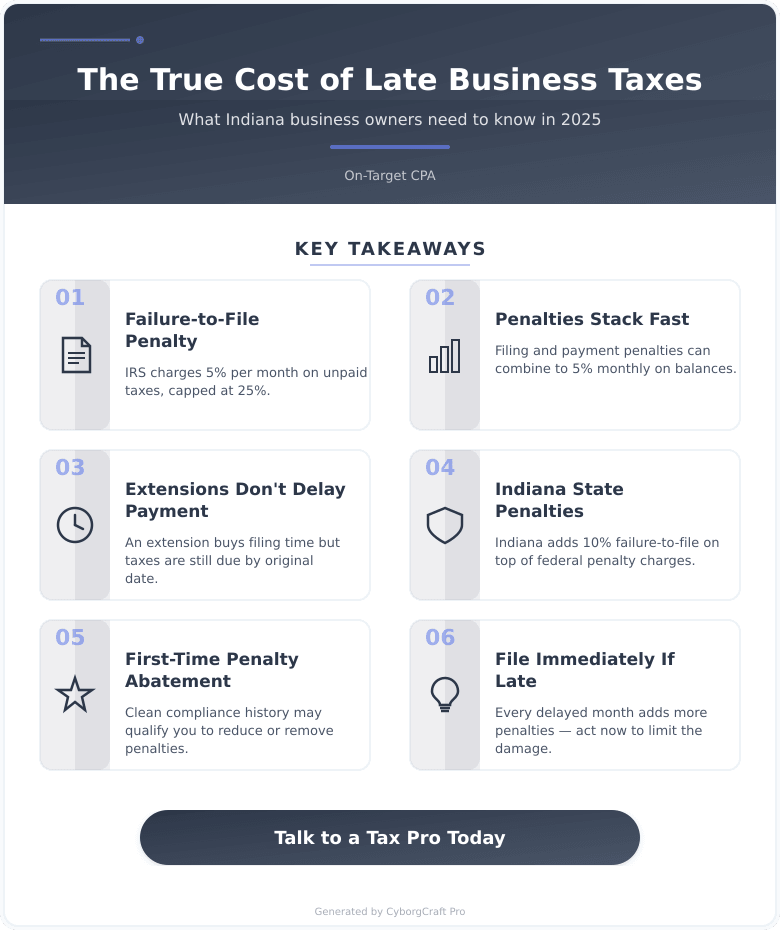
Filing a business tax return late in Indiana can cost far more than most owners realize. The IRS charges a 5% per month failure-to-file penalty on unpaid taxes, capped at 25%, plus a separate 0.5% per month failure-to-pay penalty. Indiana adds a 10% state penalty on top of unpaid state balances, and for pass-through entities like LLCs and S-Corps, those penalties can flow to individual owners as well. The post breaks down exactly how these charges stack, clarifies the critical difference between filing an extension and actually deferring payment, and explains two paths to penalty relief: First-Time Penalty Abatement for businesses with a clean three-year compliance record, and reasonable cause abatement for those who experienced genuine documented hardship. A comparison of the extension-vs-late-filing tradeoffs shows that while extensions protect against failure-to-file penalties, they do not stop payment-related penalties from running. A five-step action plan walks business owners through filing immediately, making partial payments, reviewing compliance history, documenting hardship, and formally requesting relief. The post also includes a preparation checklist so readers know exactly what to gather before consulting a CPA, plus a full FAQ section addressing common questions about timelines, Indiana-specific rules, and how long resolution typically takes. On-Target CPA serves business owners in Indianapolis, IN and surrounding communities.
Corporate Tax Return vs. Small Business Tax Return: What’s the Difference and Which One Do You Need?
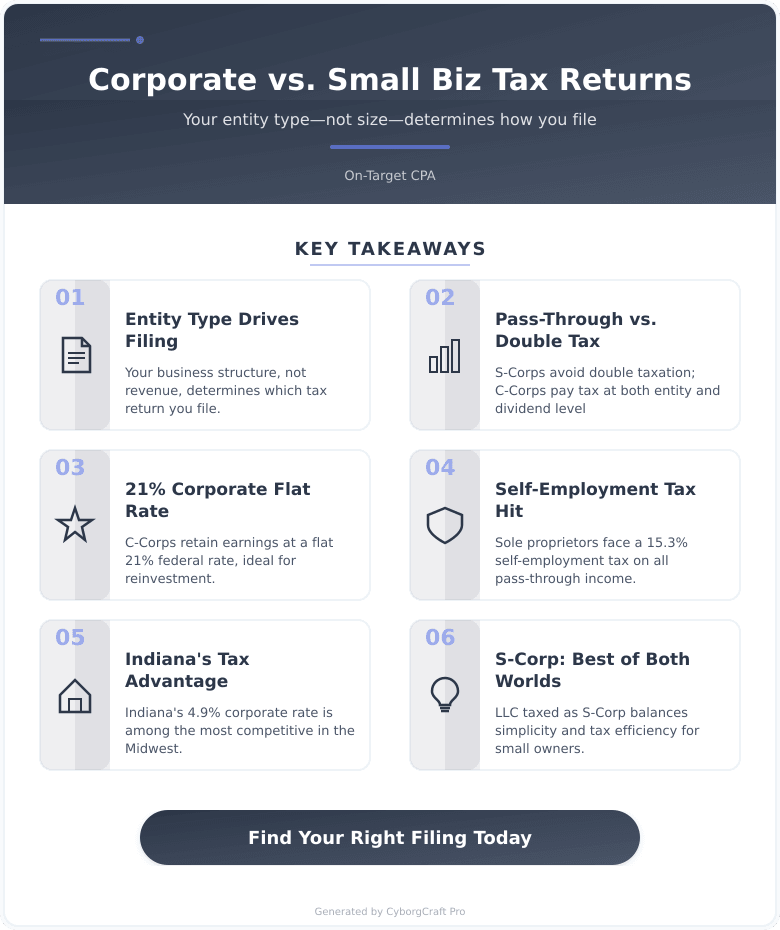
Choosing the wrong tax return type is one of the most common and costly mistakes Indiana business owners make. Your entity structure – not your revenue or headcount – determines whether you file a corporate return like Form 1120 or a pass-through return like Schedule C or Form 1065. C-Corps pay tax at the entity level at a flat 21% federal rate, but face double taxation on dividends. S-Corps and sole proprietors use pass-through treatment, meaning income flows to the owner’s personal return. Indiana’s 4.9% corporate tax rate is competitive compared to Illinois, Michigan, Ohio, and Kentucky, but still requires a separate state filing. LLCs are especially confusing because their tax treatment depends entirely on IRS elections made at formation or later. Key 2025 deadlines include March 17 for S-Corps and partnerships, and April 15 for C-Corps and sole proprietors. Filing the wrong form can trigger audits, missed deductions, and penalties. The post walks through a practical action plan, a document checklist, and a clear comparison of each entity type, form, and estimated preparation cost – giving Indianapolis business owners the clarity they need before tax season gets away from them.