Unfiled business tax returns are a situation where a business owner has missed one or more required federal or state tax filing deadlines without submitting the necessary returns to the IRS or Indiana Department of Revenue. Left unresolved, this creates compounding penalties, interest, and serious legal exposure that grows the longer it sits.

This guide focuses specifically on business owners who have missed one or more filing years and want to understand exactly what they’re facing and how to fix it.
Here’s the thing: you’re probably not alone. A surprising number of small business owners miss filing deadlines, sometimes for a single year, sometimes for several. Life gets complicated. Cash gets tight. Bookkeeping falls behind. And then one missed year turns into two, and suddenly the whole thing feels too big to touch. According to the Internal Revenue Service, millions of business returns go unfiled each year, and the IRS has active programs designed specifically to track them down.
The most common mistake we see is business owners assuming that if they didn’t make much money, they probably don’t owe anything, so filing doesn’t matter. That assumption can be costly.
What the IRS Actually Does When You Don’t File
The IRS doesn’t forget. If you missed filing a business tax return, here’s what happens behind the scenes:
- The IRS receives third-party data from banks, payment processors, and 1099 issuers
- Their automated systems flag years where income was reported but no return was filed
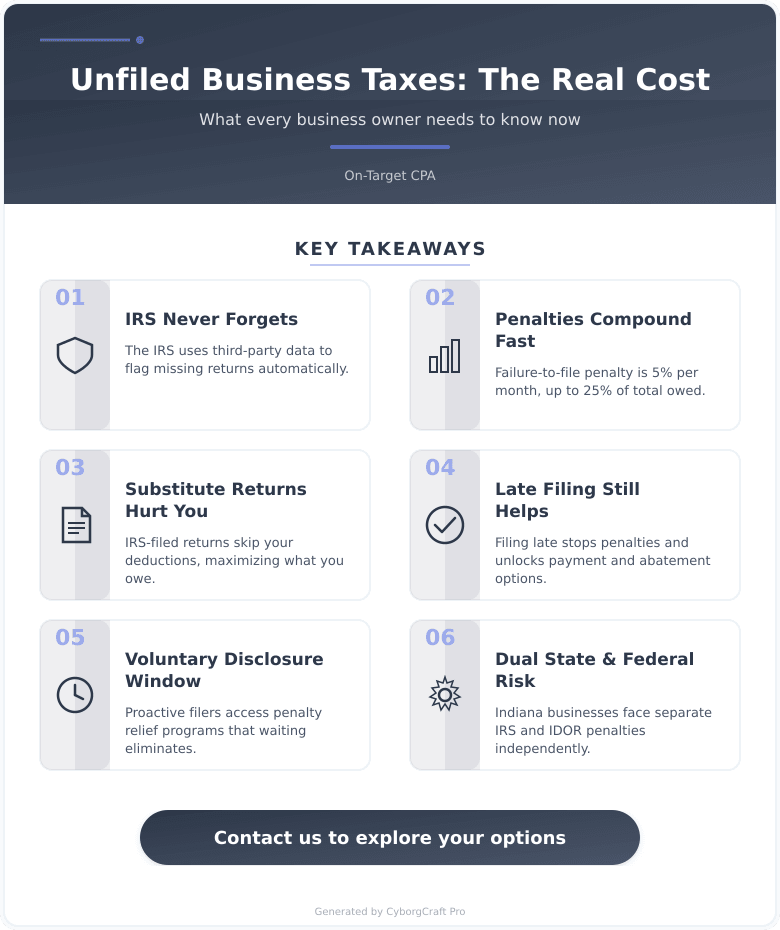
- They may file a Substitute for Return (SFR) on your behalf using their own calculations, which rarely works in your favor
- CP2000 notices and formal audit letters follow
- Liens and levies become possible once a tax balance is established
An SFR does not give you the deductions and credits you’re entitled to. The IRS files it to create a tax balance, not to minimize what you owe. That’s a big distinction.
According to IRS data, the failure-to-file penalty alone is 5% of unpaid taxes per month, up to 25% of the total balance. Stack that on top of a failure-to-pay penalty and interest, and the original tax debt can grow substantially within 12 to 18 months.
Unfiled Returns vs. Late Returns: Which Approach Works?
Where filing late succeeds: You stop penalties from accumulating further. You get to claim your actual deductions. You open the door to payment arrangements, penalty abatement, and resolution programs.
Where filing late fails: It doesn’t erase penalties already assessed. It may trigger a balance due you weren’t expecting. Without professional guidance, you might miss deductions that reduce what you owe.
Where doing nothing succeeds: Honestly, nothing. There is no scenario where ignoring unfiled returns improves your situation.
Where doing nothing fails: The IRS files an SFR and calculates your tax without your input. Penalties and interest compound daily. The IRS can pursue collection actions including levies on your bank accounts and liens on property.
The verdict: Filing late, even years late, is almost always better than not filing at all. The IRS has a Voluntary Disclosure framework and penalty abatement options that are only available to taxpayers who proactively come forward. Waiting eliminates those options.
Thinking about this for your situation? Let’s talk. We’ll walk you through your options, no pressure. Contact us to get started.
Indiana-Specific Considerations for Unfiled Business Returns
If your business operates in Indiana, you’re dealing with two separate obligations: federal returns through the IRS and state returns through the Indiana Department of Revenue (IDOR). Both can assess penalties independently.
Indiana maintains its own penalty and interest structure for unfiled and late returns. The IDOR also has processes that may allow taxpayers to address unfiled returns and resolve outstanding obligations. Taxpayers with state filing gaps should consult directly with the IDOR or a qualified tax professional to understand current options.
Indiana’s program has specific eligibility windows for resolving outstanding state obligations. Missing those windows doesn’t eliminate your options, but it does change them.
Key definition – Penalty Abatement: A formal IRS or state process where assessed penalties are reduced or removed, typically granted for first-time filers or those with reasonable cause for non-compliance.
Key definition – Substitute for Return (SFR): A return the IRS prepares on your behalf when you fail to file, calculated using available third-party data without your deductions or credits applied.
Your Unfiled Return Action Plan
- Step 1 – Identify every missing year: Pull IRS transcripts through the IRS website or work with a CPA to identify which years are outstanding. Don’t guess.
- Step 2 – Gather financial records: Collect bank statements, receipts, 1099s, and expense records for each year. Even incomplete records are better than none.
- Step 3 – Prepare and file all missing returns: File in order from oldest to most recent. This matters for penalty calculation and resolution.
- Step 4 – Assess the balance owed: Once returns are filed, you’ll know the actual tax owed, which may be far less than an SFR estimate.
- Step 5 – Explore resolution options: Payment plans, penalty abatement requests, and Offer in Compromise (settling for less than owed) all become available once returns are filed.
Documents to gather before your first consultation:
- ☐ Business bank statements for each unfiled year
- ☐ 1099s and W-2s received
- ☐ Business expense receipts and records
- ☐ Prior year tax returns if available
- ☐ Any IRS or IDOR notices received
- ☐ Payroll records if applicable
Key Takeaways for Business Owners in 2025
- Filing late beats not filing – Late returns still qualify for penalty abatement and resolution programs
- SFRs cost you money – The IRS version of your return won’t include your deductions
- Indiana has its own obligations – State unfiled returns carry separate penalties from federal ones
- Voluntary compliance helps – Coming forward before the IRS contacts you creates more options
- The problem doesn’t shrink on its own – Every month of inaction adds to the penalty and interest balance
As of early 2025, the IRS is actively expanding its compliance programs targeting small businesses with income reported through payment processors and third-party platforms. If your business collects payments through Stripe, PayPal, Square, or similar platforms, that income is already visible to the IRS whether you filed or not.
At On-Target CPA, we work with business owners across Indianapolis and Indiana who are dealing with exactly this situation. The path forward starts with knowing what you’re actually facing, and that starts with a conversation.
Frequently Asked Questions
How many years back can the IRS go for unfiled business tax returns?
The IRS can assess taxes on unfiled returns indefinitely, because the statute of limitations does not start until a return is actually filed. This means a return from 2018 that was never filed is still fully assessable in 2025. Filing, even late, starts the clock on that limitation period.
Will I automatically owe money if I file late returns?
Not necessarily, but penalties and interest will apply to any tax balance that exists. Some businesses with sufficient deductions end up owing less than expected, or nothing at all, once actual expenses are factored in. That’s why filing with proper records matters so much.
Can I negotiate with the IRS after filing late returns?
Yes, and filing is actually the first requirement to qualify for most IRS resolution programs. Payment plans, penalty abatement, and Offer in Compromise all require that returns be current before the IRS will consider your application.
What if my business had no income for the year I missed?
A zero-income year may still require a return depending on your business structure, and filing a zero return eliminates the ongoing risk of an SFR. C-corporations, S-corporations, and partnerships generally have filing requirements regardless of income. Sole proprietors below certain thresholds may have exceptions.
How much does it typically cost to catch up on unfiled returns?
CPA fees for preparing back returns vary based on complexity, business type, and how many years are involved. Generally, business return preparation runs from several hundred to over a thousand dollars per year depending on the entity type and records available. The cost of professional help is typically far less than the penalties avoided.
Does Indiana penalize unfiled returns the same way the IRS does?
Indiana has its own penalty and interest structure through the Indiana Department of Revenue, separate from federal penalties. Both can run simultaneously, meaning a business with five unfiled years could face penalties from both the IRS and IDOR. Indiana’s voluntary disclosure program may reduce state penalties for eligible taxpayers.
What is the first step I should take right now?
Request your IRS tax transcripts to see exactly which years are unfiled and what the IRS already has on record. The IRS provides free transcripts through their online portal, referenced at the IRS official website. From there, a CPA can help you build a realistic catch-up plan.
Your Next Step Starts Here
Look, the longer unfiled business tax returns sit, the more expensive and complicated they become. That’s not a scare tactic. That’s just how penalty and interest math works.
The good news: this is fixable. Businesses catch up on years of unfiled returns every day, and most of them end up in a much better position than they expected once they actually know what they’re dealing with.
Ready to take the next step? Contact us today for straight answers and real solutions. We’ll review your situation, help you understand what you actually owe, and map out a clear path forward. For a complete overview of how we can help, visit our services page.