Starting a business in Indiana is the process of legally establishing, structuring, and financially preparing a new company under Indiana state law. Getting the structure right from day one saves you from costly mistakes that can follow you for years.

This guide focuses specifically on Indiana business formation decisions, entity structure, and why CPA guidance before registration is the move that protects your money and your future.
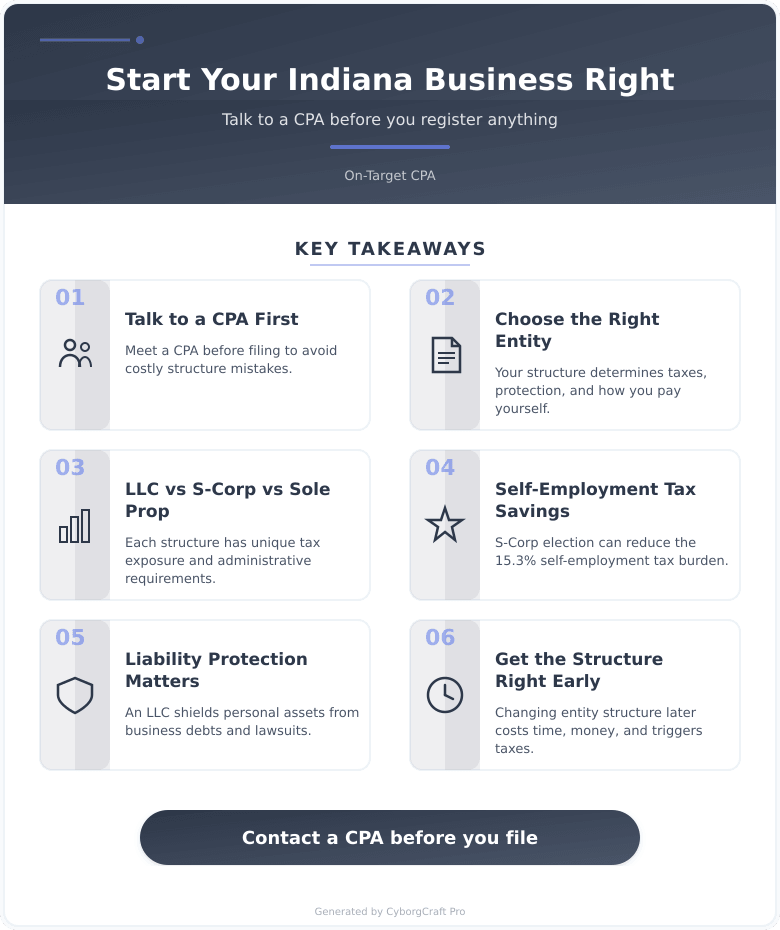
Most new business owners go straight to filing with the Indiana Secretary of State and figure out the finances later. Here’s the problem with that: your entity structure determines how you’re taxed, how you’re protected, and how you pay yourself. Changing it after the fact is possible, but it costs time, money, and sometimes triggers a taxable event. The most common mistake a CPA sees is a business owner who filed an LLC, ran it for two years, then realized they should have elected S-corp status from the beginning – and overpaid self-employment taxes the whole time.
Thinking about this for your situation? Let’s talk. Contact us and we’ll walk you through your options – no pressure.
What Starting a Business in Indiana Actually Involves
Filing with the state is just one piece of a much larger puzzle. Before you pick a name or pay a filing fee, you need clarity on three things: your legal structure, your tax obligations, and your financial setup.
Indiana LLC: A limited liability company that separates personal and business liability, with flexible tax treatment options under Indiana law.
S-Corporation election: A federal tax status that allows business income to pass through to owners while reducing self-employment tax exposure on a portion of earnings.
Indiana’s filing fee for an LLC is $90, and a for-profit corporation runs $90 (2025). Those numbers are low. What’s not low is the tax bill you can accidentally create by choosing the wrong structure. According to the IRS Small Business Tax Center, self-employment tax alone sits at 15.3% on net earnings – a number that smart entity planning can legally reduce.
LLC vs. S-Corp vs. Sole Proprietor: Which Approach Works?
| Structure | State Filing Cost (2025) | Self-Employment Tax Exposure | Best For |
|---|---|---|---|
| Sole Proprietor | $0 | Full 15.3% on all net income | Testing an idea, very low revenue |
| LLC (default) | $90 | Full 15.3% on all net income | Liability protection without complexity |
| LLC + S-Corp Election | $90 + IRS filing | Reduced – only on reasonable salary | Profitable businesses, $40K+ net income |
| C-Corporation | $90 | Not applicable – flat 21% corporate rate | Outside investors, venture-backed startups |
Where sole proprietorship succeeds: Zero setup cost, immediate start, no administrative burden.
Where sole proprietorship fails: No liability protection, full self-employment tax, no separation between personal and business finances.
Where LLC + S-Corp election succeeds: Significant self-employment tax savings, liability shield, professional credibility, pass-through taxation.
Where LLC + S-Corp election fails: Requires reasonable salary determination, payroll setup, and more administrative complexity. Not worth it below roughly $40,000 in annual net profit.
The verdict: For most Indiana small business owners expecting consistent profit, an LLC with an S-corp election – set up correctly from the start – delivers the best balance of protection and tax efficiency. A CPA can run the numbers for your specific situation before you commit.
See how our approach fits your situation – explore our services or reach out directly.
Your Indiana Business Formation Action Plan
- Step 1 – Meet with a CPA before filing anything: Discuss your projected revenue, expenses, and personal financial goals. This conversation determines your ideal structure before you spend a dime on state fees.
- Step 2 – Choose and reserve your business name: Search the Indiana Secretary of State database to confirm your name is available before you file.
- Step 3 – File your Articles of Organization or Incorporation: Submit to the Indiana Secretary of State. LLC fee: $90. Corporation fee: $90 (2025 rates).
- Step 4 – Apply for your EIN: Get your Employer Identification Number from the IRS – free and available same-day online.
- Step 5 – File S-Corp election if applicable: Submit IRS Form 2553 within 75 days of formation, or by March 15 for the prior tax year. Missing this window means waiting another full year.
- Step 6 – Open a dedicated business bank account: Never mix personal and business funds. This is non-negotiable for both liability protection and clean bookkeeping.
- Step 7 – Register for Indiana tax obligations: Register with the Indiana Department of Revenue for sales tax, withholding, and any applicable business taxes. Indiana’s corporate income tax rate is 4.9% (2025).
What to Gather Before Your First CPA Meeting
- ☐ Projected annual revenue estimate (even a rough range helps)
- ☐ List of anticipated business expenses
- ☐ Your personal tax filing status (single, married filing jointly, etc.)
- ☐ Any existing business debts or assets you’re bringing in
- ☐ Names of any business partners or co-owners
- ☐ Industry type – some Indiana industries have specific licensing requirements
- ☐ Whether you plan to hire employees in the first year
Indiana vs. Neighboring States: Formation Comparison
| State | LLC Filing Fee (2025) | Annual Report Fee | State Income Tax Rate |
|---|---|---|---|
| Indiana | $90 | $32 | 3.05% individual / 4.9% corporate |
| Illinois | $150 | $75 | 4.95% flat individual |
| Ohio | $99 | $0 (no annual report) | Graduated up to 3.75% |
| Michigan | $50 | $25 | 4.25% flat individual |
| Kentucky | $40 | $15 | 4.0% flat individual |
Indiana’s LLC fee is mid-range compared to its neighbors. The real differentiator isn’t the filing cost – it’s how Indiana’s tax structure interacts with your chosen entity type. That’s exactly the kind of analysis worth having before you commit to a structure.
Mistakes That Derail Indiana Startups Early
The pattern is consistent. Business owners make the same handful of errors that create headaches down the road:
- Filing as an LLC but never making the S-corp election, leaving significant self-employment tax savings on the table
- Skipping the biennial business entity report (due every two years in Indiana) and losing good standing
- Not registering for Indiana sales tax when selling taxable goods or services
- Failing to set a reasonable salary as an S-corp owner, which draws IRS scrutiny
- Mixing personal and business accounts, which can pierce your liability protection
Key Takeaways for Indiana Business Owners in 2025
- Entity structure is a tax decision – choose wrong and you overpay for years
- The S-corp election window is short – 75 days from formation or you wait a full year
- Indiana’s filing fees are low – $90 for an LLC (2025) – but the tax implications are what really matter
- Indiana corporate income tax dropped to 4.9% in 2025 – relevant if you’re considering a C-corp structure
- CPA input before filing is always cheaper than restructuring after the fact
At On-Target CPA, serving Indianapolis, IN and surrounding areas, this is exactly the kind of planning conversation we have with new business owners every week. The businesses that start right are the ones that build on a foundation that doesn’t crack when growth starts.
Frequently Asked Questions
How much does it cost to start a business in Indiana in 2025?
The state filing fee for an Indiana LLC is $90 and for a corporation is $90 (2025 rates). Beyond filing fees, budget for an EIN application (free), a registered agent if needed ($50-$300/year), and CPA consultation fees that vary by provider and scope of work.
Do I need a CPA to start a business in Indiana?
Indiana doesn’t legally require a CPA to form a business, but working with one before filing is one of the highest-return decisions a new owner can make. Entity structure choices affect your taxes for years, and correcting a bad decision later costs more than getting it right from the start.
What is the best business structure for a small business in Indiana?
For most profitable Indiana small businesses, an LLC with an S-corporation tax election offers the strongest combination of liability protection and tax efficiency. The right answer depends on your revenue, expenses, and growth plans – which is why a CPA review before filing matters.
When is the S-corp election deadline in Indiana?
You must file IRS Form 2553 within 75 days of forming your business, or by March 15 of the current tax year to apply retroactively to the prior year. Missing this window means waiting a full tax year, which can mean real money in unnecessary self-employment taxes.
Does Indiana require an annual report for LLCs?
Indiana LLCs file a biennial report (every two years) with the Secretary of State, with a $32 fee (2025). Missing this filing puts your business out of good standing, which can affect your ability to open bank accounts or sign contracts.
What taxes does a new Indiana business owe?
Indiana businesses may owe state income tax at 4.9% (corporations, 2025), sales tax at 7% if selling taxable goods or services, and employer withholding if you have employees. The federal self-employment tax of 15.3% also applies to sole proprietors and LLC members unless they’ve structured around it.