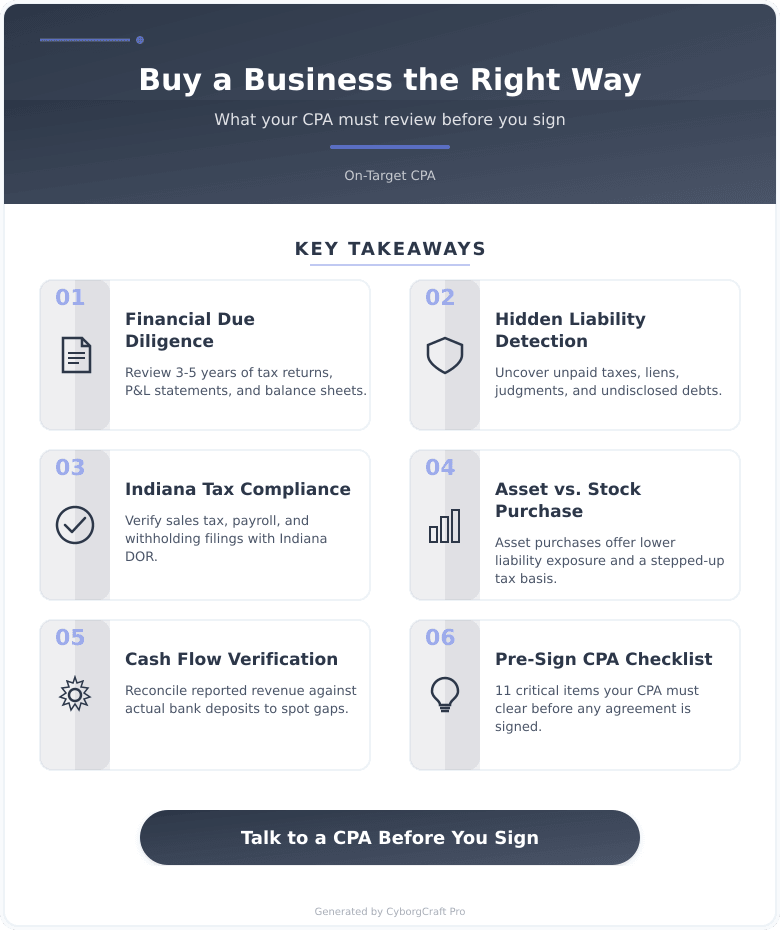
Business acquisition CPA review is a structured financial and tax analysis performed before a business purchase closes. It protects buyers from inheriting hidden debts, tax liabilities, and inflated valuations that can quietly destroy a deal.

This guide focuses specifically on what Indianapolis-area buyers should have their CPA examine before signing any purchase agreement.
Buying a business is one of the largest financial decisions most people make. The excitement is real. But the paperwork that comes after? That’s where deals go wrong. A thorough business acquisition CPA review is the difference between walking into a profitable operation and inheriting someone else’s financial mess.
According to recent U.S. Small Business Administration data, about 21.5% of small businesses fail within the first year – many of those failures trace back to undiscovered pre-purchase liabilities. That number drops significantly when buyers conduct proper financial due diligence.
Why Most Business Buyers Skip the CPA – And Pay for It Later
The most common mistake we see is buyers relying solely on the seller’s tax returns at face value. Tax returns show what was reported – not necessarily what’s real. Sellers have every incentive to present their financials favorably. Your CPA’s job is to read between the lines.
Cash-heavy businesses are especially risky. Restaurants, retail shops, and service companies with lots of cash transactions can show revenue that doesn’t match actual bank deposits. A CPA will reconcile those figures and flag the gaps.
Here in Indiana, buyers also face state-specific obligations that out-of-state sellers may not fully disclose. Indiana’s Department of Revenue can hold a new business owner responsible for a predecessor’s unpaid sales tax, payroll tax, or withholding liabilities under certain asset purchase structures.
The Business Acquisition CPA Review Checklist
Before any purchase agreement gets signed, your CPA should work through all of the following:
- ☐ Three to five years of federal and state tax returns
- ☐ Profit and loss statements (reviewed, not just accepted)
- ☐ Balance sheets with asset verification
- ☐ Accounts receivable aging reports
- ☐ Payroll records and Indiana withholding tax filings
- ☐ Sales tax compliance history with the Indiana DOR
- ☐ Outstanding liens, judgments, or UCC filings
- ☐ Lease agreements and rent obligations
- ☐ Equipment appraisals and depreciation schedules
- ☐ Inventory counts and valuation method
- ☐ Any pending audits or IRS correspondence
Thinking about this for your situation? Let’s talk. We’ll walk you through your options – no pressure. Contact us to schedule a conversation with the On-Target CPA team before you move forward.
Asset Purchase vs. Stock Purchase: Which Approach Works?
Where an asset purchase succeeds: Buyers can choose which assets and liabilities to take on, often avoiding inherited tax debt. It also gives buyers a stepped-up tax basis, which reduces future depreciation costs.
Where an asset purchase fails: More complex to execute, requires retitling assets individually, and some contracts (like leases) may not transfer automatically.
Where a stock purchase succeeds: Simpler transfer of ownership, contracts and licenses typically carry over, and sellers often prefer this structure for tax reasons.
Where a stock purchase fails: Buyers inherit all liabilities – disclosed and undisclosed. Past tax problems, lawsuits, and vendor disputes follow the entity.
The verdict: For most Indianapolis small business purchases, an asset purchase gives buyers stronger protection. Your CPA and attorney should align on the structure before negotiations finalize.
| Structure | Buyer Tax Benefit | Liability Exposure | Best For |
|---|---|---|---|
| Asset Purchase | Stepped-up basis (2025) | Lower – selective liabilities | Small to mid-size deals |
| Stock Purchase | Limited basis adjustment | Higher – full entity history | Large entities, complex contracts |
Indiana-Specific Tax Issues That Can Derail a Deal
Indiana has a few quirks buyers need to know about. Under current Indiana law (2025), purchasing a business that has unpaid sales tax can expose the buyer to successor liability if the proper clearance certificates aren’t obtained from the Indiana Department of Revenue before closing.
Successor liability: A legal concept where a new business owner becomes responsible for the prior owner’s tax or financial obligations if proper steps aren’t taken during the acquisition.
Tax clearance certificate: An official document from the Indiana DOR confirming the seller has no outstanding state tax obligations – critical to request before any closing.
Compared to neighboring states, Indiana’s process is fairly straightforward. Ohio and Illinois have similar successor liability rules, but Michigan’s clearance process tends to take longer – sometimes adding weeks to a deal timeline. Kentucky has a less formalized process but still carries transferable risk.
Recent shifts in how Indiana handles pass-through entity taxation also matter here. As of 2025, Indiana allows pass-through entities to elect to pay tax at the entity level. If the business you’re buying has made that election, the structure affects how you’ll handle taxes post-acquisition. A CPA review catches this before it becomes your problem.
See how our approach compares – explore our services to understand what a pre-acquisition financial review actually involves.
Your Business Acquisition Action Plan
- Step 1 – Engage your CPA early: Bring your CPA in before you make an offer, not after. Early involvement shapes the purchase price and structure.
- Step 2 – Request three to five years of financials: Don’t accept summaries. Request actual tax returns, bank statements, and P&L reports for full picture verification.
- Step 3 – Order an Indiana DOR tax clearance: Confirm the seller has no outstanding Indiana tax liabilities before closing.
- Step 4 – Run a UCC lien search: Check for any liens filed against business assets through the Indiana Secretary of State’s office.
- Step 5 – Validate normalized earnings: Your CPA should recast the financials to remove owner-specific expenses and one-time items to find true business profitability.
- Step 6 – Confirm the purchase structure with your attorney: Asset vs. stock purchase affects your tax exposure for years after closing.
Key Takeaways for Business Buyers in 2025
- Get your CPA involved before negotiations finalize – structure decisions made early save money at closing and beyond.
- Indiana successor liability is real – always obtain a tax clearance certificate from the Indiana DOR before closing.
- Asset purchases generally favor buyers – they limit inherited liabilities and offer a stepped-up tax basis.
- Normalized earnings tell the real story – recast financials reveal what the business actually earns, not what the seller wants you to see.
- 2026 planning starts at acquisition – how you structure the deal today shapes your Indiana tax position for years ahead.
Frequently Asked Questions
What does a CPA review for a business acquisition actually include?
A business acquisition CPA review covers tax returns, financial statements, payroll records, and outstanding liabilities. It also includes a recast of earnings to show normalized profitability and flags any Indiana-specific tax compliance issues before closing.
How much does a pre-acquisition CPA review cost in Indiana?
Pre-acquisition financial due diligence typically ranges from $1,500 to $5,000 depending on business complexity and deal size. Larger deals or those involving multiple entities can run higher. This cost is almost always recovered through better purchase price negotiation or avoided liabilities.
Can I be held responsible for the previous owner’s Indiana taxes?
Yes – under Indiana successor liability rules, buyers can inherit unpaid sales tax and withholding obligations if a clearance certificate isn’t obtained before closing. Your CPA and attorney should coordinate this step before any funds change hands.
What is normalized earnings recasting and why does it matter?
Normalized earnings recasting adjusts a business’s financial statements to remove non-recurring expenses and owner-specific costs, showing what the business truly earns. This directly affects valuation and is one of the most important steps in any acquisition review.
How long does a CPA due diligence review take?
Most CPA due diligence reviews take two to four weeks depending on how quickly sellers provide documentation. Complex deals with multiple entities or years of incomplete records can take longer. Starting early protects your closing timeline.
Should I use an asset purchase or stock purchase structure?
For most Indianapolis small business deals, an asset purchase provides stronger buyer protection by limiting inherited liabilities. Stock purchases are sometimes preferred for larger businesses where contracts and licenses don’t transfer easily. Your CPA and attorney should align on structure before the letter of intent is signed.
Ready to Buy Smart, Not Just Fast?
A business purchase is exciting. And it should stay that way – not turn into a lesson learned the hard way about inherited tax debt or inflated books. At On-Target CPA, based in Indianapolis, IN, we work alongside buyers at every stage of the acquisition process, from early financial review through closing and post-purchase tax planning.
The latest data from business transaction advisors shows that buyers who complete thorough CPA due diligence before signing close deals with fewer surprises and better long-term financial outcomes. That’s not a coincidence.
Ready to take the next step? Contact OnTarget CPA at (317) 820-2000 or reach out online today for straight answers and real solutions before you sign anything.