Late business tax filing is the act of submitting a federal or state business tax return after the IRS or Indiana Department of Revenue deadline without an approved extension. It triggers automatic penalties, interest charges, and potential compliance flags that compound quickly if left unaddressed.

This guide focuses specifically on Indiana business owners facing late filing situations in 2025 – what it actually costs, how to minimize the damage, and what steps to take right now.
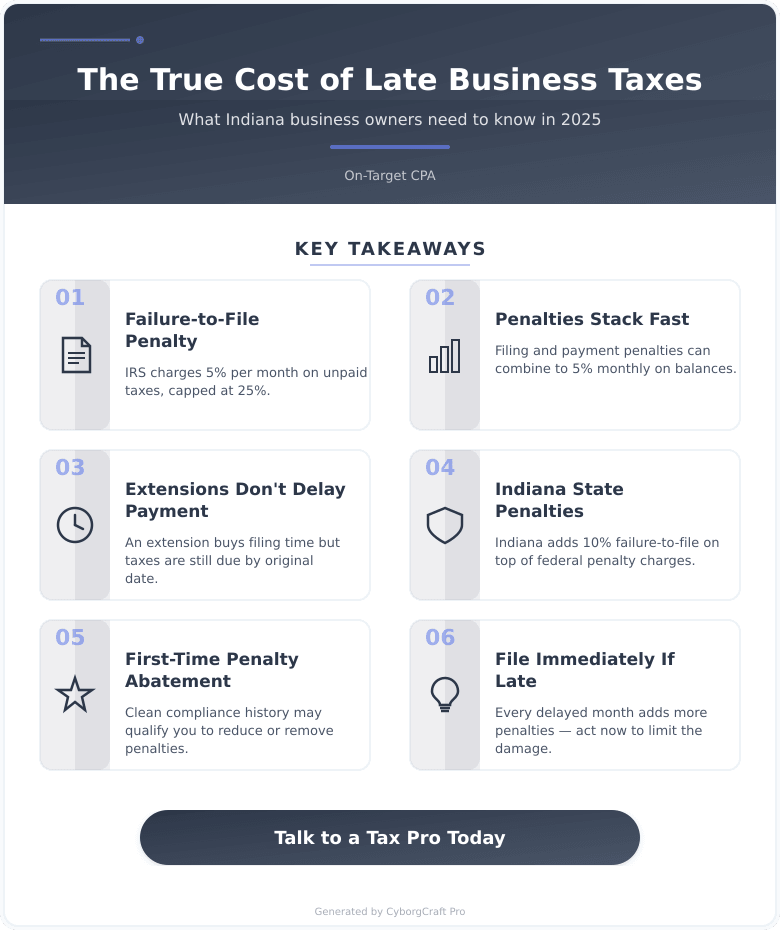
A lot of business owners assume a late return is a minor inconvenience. It rarely is. The IRS failure-to-file penalty alone runs 5% of unpaid taxes per month, capped at 25%. Add state-level Indiana penalties, interest, and the ripple effects on your business credit, and what started as a missed deadline can turn into a serious financial problem fast.
What Late Business Tax Filing Actually Costs You
Failure-to-File Penalty: The IRS charges 5% of unpaid taxes for each month (or partial month) your return is late, up to a maximum of 25%.
Failure-to-Pay Penalty: Separate from the filing penalty, this runs 0.5% per month on unpaid balances and also caps at 25%.
According to the IRS official penalty relief guidance, these two penalties can run simultaneously, meaning a business that filed late and still owes taxes could face combined penalty rates of 5% per month. On a $20,000 tax bill, that is $1,000 every single month you delay.
Indiana adds its own layer. The Indiana Department of Revenue imposes penalties and interest on unpaid state taxes for late returns. Indiana business entities, including those structured as pass-throughs, should be aware that state-level obligations may affect multiple parties within the business, compounding the problem across your whole ownership group.
| Penalty Type | Federal Rate (2025) | Indiana Rate (2025) |
|---|---|---|
| Failure-to-File | 5% per month (max 25%) | 10% of unpaid tax |
| Failure-to-Pay | 0.5% per month (max 25%) | Interest at adjusted prime rate |
| Combined Maximum | Up to 47.5% of tax owed | Varies by amount and duration |
Extension vs. Late Filing: Which Approach Works?
Where filing an extension succeeds: An approved extension gives most business entities until September 15, 2025 (partnerships and S-Corps) or October 15, 2025 (C-Corps) to file without incurring a failure-to-file penalty. It buys legitimate time and avoids the most aggressive penalty rates.
Where filing an extension fails: Extensions do not extend your payment deadline. If you owe taxes and do not pay by the original due date, the failure-to-pay penalty starts accumulating immediately regardless of the extension. Many business owners miss this distinction and get hit with unexpected penalties even after filing for more time.
Where simply filing late succeeds: Sometimes filing late is unavoidable. If your records were in disarray or a financial event disrupted operations, getting the return submitted as soon as possible – even late – limits how far the penalties can grow.
Where simply filing late fails: Every month without a filed return is another 5% penalty on what you owe. Waiting months to address the situation is almost always more expensive than any other option.
The verdict: If you have not yet missed the deadline, file an extension and pay your best estimate of taxes owed by the original due date. If the deadline has passed, file the return immediately and explore penalty abatement options – do not wait.
Thinking about this for your situation? Let’s talk. Contact us and we will walk you through your options – no pressure.
IRS Penalty Abatement: What Indiana Business Owners May Not Know
The IRS does have programs to reduce or remove penalties for qualifying taxpayers. The most accessible is First-Time Penalty Abatement (FTA), which the IRS describes in its official abatement policy. If your business has a clean compliance history – meaning you filed and paid on time for the prior three years – you may qualify to have certain penalties waived simply by requesting it.
Recent data shows that a significant percentage of eligible taxpayers never request abatement and end up paying penalties they did not have to pay. The most common mistake we see is business owners assuming penalties are non-negotiable. Many are not.
Beyond FTA, reasonable cause abatement applies when a serious event – illness, natural disaster, destruction of records – genuinely prevented timely filing. The bar is real, but for businesses that experienced genuine hardship in 2024 or early 2025, it may apply.
Your Late Filing Action Plan
- Step 1 – File immediately: Get the return submitted as soon as possible. Every additional month without a filed return adds another 5% to your penalty stack.
- Step 2 – Pay what you can: Even a partial payment stops interest from accruing on that portion and demonstrates good faith to the IRS.
- Step 3 – Review your compliance history: Check whether your business qualifies for First-Time Penalty Abatement based on the prior three-year clean filing record.
- Step 4 – Document any hardship: If a serious event caused the delay, gather records now – medical records, disaster notices, correspondence – before details fade.
- Step 5 – Request abatement or set up a payment plan: Work with a CPA to formally request penalty relief or establish an IRS installment agreement if the full balance is not payable at once.
What to Gather Before You Talk to a CPA
- ☐ Prior year federal and Indiana business tax returns
- ☐ Any IRS or Indiana DOR notices received
- ☐ Bank statements and financial records for the filing year
- ☐ Documentation of any hardship event that caused the delay
- ☐ Records of any estimated tax payments already made
- ☐ Current balance owed (check IRS Online Account or request a transcript)
Key Takeaways for Indiana Business Owners in 2025
- Penalties compound fast – the IRS failure-to-file penalty runs 5% per month up to 25%, separate from the failure-to-pay penalty
- Extensions do not extend payment – you still owe estimated taxes by the original deadline even with a valid extension
- Indiana adds its own penalties – 10% state penalty on unpaid tax applies on top of federal charges
- First-Time Abatement is real – qualifying businesses with a clean prior compliance record can request penalty removal
- Filing late is still better than not filing – getting the return submitted stops the failure-to-file penalty from growing further
See how our approach can help reduce what you owe. For a complete overview, visit our services page or get in touch today.
Frequently Asked Questions
What is the penalty for filing a business tax return late in 2025?
The IRS charges 5% of unpaid taxes per month for failure to file, up to a maximum of 25%. A separate failure-to-pay penalty of 0.5% per month also applies, and Indiana adds a 10% state penalty on top of any unpaid state tax balance.
Does filing a tax extension eliminate late penalties?
Filing an extension eliminates the failure-to-file penalty but does not eliminate the failure-to-pay penalty if you owe taxes. You must pay your estimated tax balance by the original deadline – not the extended one – to avoid the payment-related penalty.
Can the IRS waive late filing penalties for businesses?
Yes, the IRS can waive penalties through First-Time Penalty Abatement or reasonable cause relief. Businesses with a clean three-year compliance history often qualify for FTA, while those who experienced documented hardship may qualify under reasonable cause standards.
How does late business tax filing affect my Indiana state taxes?
Indiana imposes penalties and interest on unpaid state taxes for late returns. Business owners should consult with a tax professional to understand how state-level obligations may affect their specific entity structure and overall financial exposure.
What should I do if I missed the business tax deadline this year?
File the return as soon as possible and pay any amount you can toward the balance owed. Then consult a CPA to evaluate your eligibility for penalty abatement and, if needed, set up an IRS installment agreement to manage the remaining balance.
How long does it take to resolve a late filing situation with the IRS?
Simple cases where a return is filed and penalties are requested for abatement can resolve in 4-12 weeks. More complex situations involving large balances, installment agreements, or offer-in-compromise negotiations typically take several months to fully resolve.
Take Action Before Penalties Grow Further
Every week without action is another week of interest and penalties building on your balance. The good news is that most late filing situations are fixable – but the window for the easiest solutions narrows the longer you wait.
At On-Target CPA, we work with business owners across Indianapolis, IN and the surrounding area to address late filings, evaluate penalty abatement options, and build a path forward that makes financial sense. We have seen the full range of these situations and know what the IRS and Indiana DOR actually respond to.
Ready to stop the penalties from compounding? Contact us today for a straightforward conversation about your options. The sooner you act, the more we can do to help.