An IRS letter is an official written notice from the Internal Revenue Service informing a taxpayer or business of a specific action, question, or required response regarding their tax account. Ignoring one – even by a few weeks – can turn a small issue into a costly problem.
This guide focuses specifically on what Indianapolis business owners should do the moment an IRS letter arrives, how to read it correctly, and when to bring in professional help.
The most common mistake we see is panic followed by inaction. Business owners open the envelope, see the IRS letterhead, and set it on the desk hoping it disappears. It won’t. But here’s the good news – most IRS letters are not the disaster they feel like on first read. Many are routine notices that require a simple response or no response at all.
IRS Notice Definition: An IRS notice is a formal document issued by the Internal Revenue Service that communicates a specific finding, adjustment, or request related to a taxpayer’s account – each notice carries a unique CP or LTR code that tells you exactly what the IRS is asking.
Read the Letter Before You React
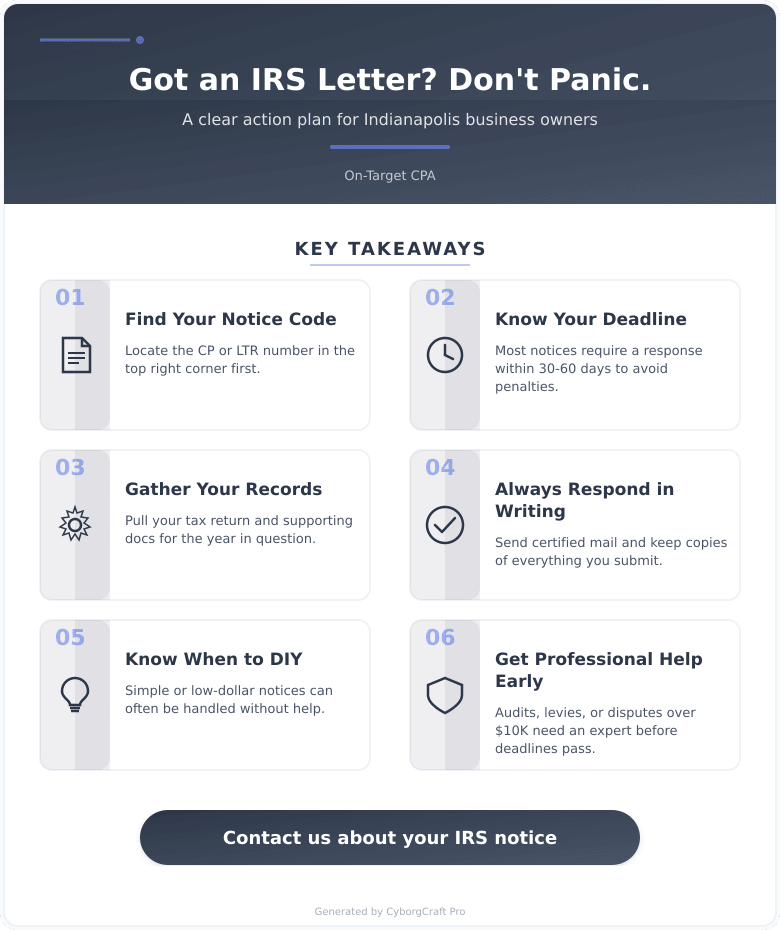
Every IRS letter has a notice number printed in the upper right corner – usually starting with “CP” or “LTR.” That code tells the whole story. A CP2000, for example, means the IRS found income on your return that doesn’t match what third parties reported. A CP14 means you have a balance due. An LT11 is a final notice before a levy.
According to the IRS official notice library, there are over 100 different notice types – and each one requires a different response strategy. Reading the code before doing anything else saves time and prevents costly mistakes.
CP Notice: A computer-generated notice triggered by automated IRS systems that cross-reference tax return data against third-party reports like W-2s and 1099s.
LTR Notice: A letter issued by an IRS agent or department requiring direct human review and a more detailed written response.
Your IRS Letter Response Action Plan
- Step 1 – Locate the Notice Number: Find the CP or LTR code in the top right corner. This determines every action you take next.
- Step 2 – Note the Response Deadline: Most notices give you 30-60 days to respond. Missing this window can trigger penalties, interest, or collection action.
- Step 3 – Pull Your Tax Records: Gather the tax return, supporting documents, and any prior IRS correspondence related to the same tax year mentioned in the letter.
- Step 4 – Determine If You Agree or Disagree: If the IRS is correct, you may simply owe money or need to file an amended return. If they are wrong, you will need documentation to dispute the finding.
- Step 5 – Respond in Writing: Always respond in writing, even if you call first. Keep copies of everything you send. Use certified mail.
- Step 6 – Track Your Case: After responding, follow up if you have not heard back within 30 days. IRS processing times can stretch longer during peak periods.
Thinking about this for your situation? Let’s talk. Contact us and we will walk you through your specific notice – no pressure, no guessing.
Handling It Yourself vs. Getting Professional Help
Where handling it yourself succeeds: Simple informational notices (CP88, CP59) that just ask for a missing return or updated information. Low-dollar balance due notices where you agree with the amount and can pay.
Where handling it yourself fails: Any notice involving audits, tax liens, levies, or penalties over $10,000. Situations where you genuinely disagree with the IRS finding and need to build a documented case.
Where professional help succeeds: CP2000 underreporter notices, audit reconsiderations, installment agreement negotiations, and any situation where multiple tax years are involved.
Where professional help fails: Bringing in help too late – after a deadline has passed or after a levy has already been issued – limits the available options significantly.
The verdict: For anything beyond a simple balance due or informational request, work with a CPA who handles IRS correspondence regularly. The cost of professional help is almost always less than the cost of a misstep.
| Notice Type | What It Means | Typical Response Window | DIY-Friendly? |
|---|---|---|---|
| CP14 | Balance due | 21 days | Often yes |
| CP2000 | Income discrepancy | 60 days | Rarely – complex |
| LT11 | Final levy notice | 30 days | No – act immediately |
| CP90 | Intent to seize assets | 30 days | No – get help now |
| CP59 | Missing return request | 30 days | Usually yes |
What Indianapolis Business Owners Often Get Wrong
From what we have seen working with business owners in Indianapolis, IN, a few patterns show up repeatedly. First, people assume silence means the problem went away. The IRS does not forget. Second, business owners sometimes respond to the wrong address or forget to include their EIN, which delays processing by weeks. Third, many people send payment without disputing a finding they actually disagree with – and once payment is made, recovering that money is much harder.
The IRS Taxpayer Advocate Service has consistently reported that a significant volume of IRS notices go unanswered, resulting in penalties that could have been reduced or eliminated with a timely written response.
See how our approach compares – explore our services to understand what a structured IRS response process actually looks like.
Documents to Gather Before You Respond
- The original IRS notice with the notice number and tax year clearly visible
- Your filed tax return for the year referenced in the letter
- All W-2s, 1099s, and business income records for that year
- Any prior IRS correspondence related to the same issue
- Proof of payments already made (bank statements, canceled checks)
- Any amended returns filed after the original submission
Key Takeaways for Indianapolis Business Owners in 2025
- Read the notice number first – it tells you what the IRS actually wants before you assume the worst
- Deadlines are hard – missing a response window can trigger penalties that far exceed the original issue
- Always respond in writing – phone calls are not documented; written responses create a paper trail
- Not all notices mean you owe money – some are purely informational and require no payment
- 2025 IRS enforcement is active – the agency increased audit and correspondence activity this year, making timely responses more important than ever
Frequently Asked Questions
What should I do first when I get an IRS letter?
Read the notice number in the upper right corner before doing anything else. That code tells you what the IRS is asking and how urgently you need to respond. Do not assume the worst until you understand the specific notice type.
How long do I have to respond to an IRS notice?
Most IRS notices give you 30 to 60 days to respond, depending on the notice type. Missing that window can trigger additional penalties or automatic collection action, so mark the deadline the moment you open the letter.
Does every IRS letter mean I owe money?
No – many IRS notices are purely informational or are requesting missing documentation rather than payment. A CP59, for example, simply asks why a return was not filed. Always read the notice fully before assuming a balance is due.
What happens if I ignore an IRS letter?
Ignoring an IRS letter escalates the situation automatically. The IRS will issue follow-up notices with increasing urgency, and unresolved issues can lead to liens on business assets, levies on bank accounts, or wage garnishment.
Should I call the IRS or respond in writing?
Always respond in writing, even if you also call. Phone conversations with the IRS are not officially documented in most cases. A written response sent via certified mail creates a verifiable record that protects you if the issue continues.
Can a CPA negotiate with the IRS on my behalf?
Yes – a licensed CPA can represent business owners before the IRS using a power of attorney (Form 2848). This allows the CPA to communicate directly with the IRS, respond to notices, and negotiate payment arrangements or penalty reductions on your behalf.
How much does it cost to get help with an IRS notice?
Professional fees for IRS notice response vary based on complexity, but simple notices typically cost less than the penalties avoided by responding correctly. Industry ranges for notice response assistance generally run from a few hundred dollars for straightforward letters to several thousand for audit-related matters.
What to Do Right Now
If an IRS letter is sitting on your desk today, do not wait. Pull out the notice, find the code, check the deadline, and start gathering your records. The situation is almost always more manageable than it looks at first – but only if you act within the window the IRS gives you.
At On-Target CPA, we work with business owners across Indianapolis, Indiana to make sense of IRS correspondence and respond the right way the first time. Whether your notice is simple or complicated, getting clarity early is always the right move.
Ready to take the next step? Contact us today for straight answers and real solutions – because the deadline on that letter is not waiting.