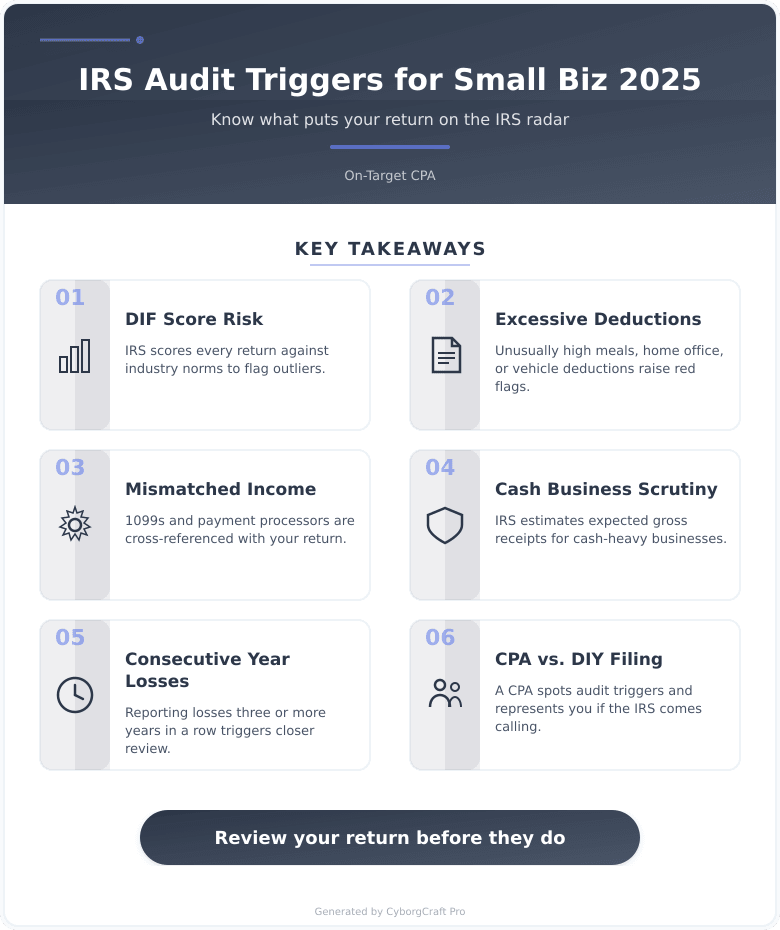
IRS audit triggers for small businesses are specific patterns, discrepancies, or filing behaviors that increase the likelihood the IRS will select your return for examination. Knowing which triggers are active in 2025 gives you a real chance to stay off their list.

This guide focuses specifically on the IRS audit triggers most likely to affect small business owners filing in 2025.
IRS Audit Trigger Definition: An IRS audit trigger is any data point, ratio, or reporting pattern on a tax return that the IRS’s automated systems or agents flag as inconsistent, unusual, or worthy of closer review.
The IRS received a significant funding boost through 2023 and 2024, and that money is actively flowing into small business enforcement in 2025. According to IRS.gov, the agency has publicly committed to increasing audit rates for businesses that show specific red flags. The most common mistake we see small business owners make is assuming their return looks fine because they filed on time. Filing on time and filing accurately are two very different things.
At On-Target CPA, we work with small business owners across Indianapolis, IN, and the surrounding area to help them understand exactly where their exposure sits before the IRS ever comes knocking.
Why 2025 IRS Audit Triggers Are Different from Prior Years
The IRS upgraded its data matching technology significantly in 2024 and those improvements are fully operational in 2025. The agency now cross-references third-party data from payment processors, banks, and 1099 filers with far greater speed and accuracy than before. Small business audit rates have drawn increased attention as the IRS expands its enforcement capabilities.
Discriminant Income Function (DIF) Score: A numerical score the IRS assigns to every return based on how much it deviates from expected norms for similar businesses in the same industry and revenue range.
What drives a high DIF score in 2025? A few things stand out this year more than others.
The Top IRS Audit Triggers Small Businesses Face in 2025
- Claiming unusually high deductions relative to reported income
- Large or rounded-number business meal and entertainment deductions
- Home office deductions that seem disproportionate to the business size
- Vehicle deductions with 100% business use claimed
- Mismatched income between your return and third-party 1099s
- Consistent losses reported for three or more consecutive years
- Cash-heavy businesses with income that does not match industry norms
- Late or missing payroll tax deposits
According to the Taxpayer Advocate Service, unreported income remains one of the IRS’s top enforcement priorities in 2025. If your business processes a significant volume of cash transactions, the IRS has analytical tools that estimate what your gross receipts should look like based on your industry. If your reported income falls far below that estimate, expect scrutiny.
Thinking about where your own return stands? Let’s talk. We’ll walk you through your specific situation and flag any issues before they become bigger problems. Contact us for a straightforward conversation.
DIY Filing vs. Working with a CPA: Which Approach Works?
Where DIY filing succeeds: Lower cost upfront, fast turnaround for simple returns, and works reasonably well if your business has straightforward income and few deductions.
Where DIY filing fails: Software cannot flag your deduction ratios against IRS norms, cannot advise on documentation requirements, and cannot identify when a legal deduction still raises a red flag. Most DIY platforms also do not prepare you for an audit or represent you during one.
Where working with a CPA succeeds: A CPA reviews your return against current IRS audit triggers for small businesses, ensures documentation supports every deduction, and can represent you if you receive an audit notice. Firms that implement proactive CPA review typically avoid the most common and costly trigger patterns entirely.
Where working with a CPA fails: Higher upfront cost and requires gathering documentation ahead of your appointment. Neither concern outweighs the risk of an audit.
The verdict: For small businesses with employees, multiple deductions, or cash-based income, DIY filing in 2025 creates real and avoidable audit risk. A CPA pays for itself the moment it keeps you out of an IRS examination.
| Approach | Typical Annual Cost | Audit Protection | Best For |
|---|---|---|---|
| DIY Software | $0 – $200 (2025) | None | Solo, simple returns |
| Enrolled Agent | $300 – $700 (2025) | Moderate | Basic business returns |
| CPA Firm | Varies based on business complexity | Strong | Multi-deduction businesses |
Your IRS Audit Risk Action Plan
- Step 1 – Reconcile all income sources: Compare every 1099, payment processor statement, and bank deposit against what you reported. Any mismatch is a trigger.
- Step 2 – Document every deduction: Receipts alone are not always enough. Vehicle logs, meeting records, and written business purpose notes are what survive an audit.
- Step 3 – Review your deduction ratios: Check whether your meals, home office, and vehicle deductions look reasonable relative to your gross income and industry peers.
- Step 4 – Check payroll tax deposits: Late or inconsistent deposits are a direct trigger. Confirm all deposits are on schedule before filing.
- Step 5 – Consult a CPA before filing: A professional review catches trigger patterns before the IRS does. Our services include return review for exactly this reason.
Pre-Filing Preparation Checklist:
- ☐ All 1099s collected and reconciled with reported income
- ☐ Mileage logs completed and totals verified
- ☐ Home office square footage calculated and documented
- ☐ Business meal receipts include date, attendees, and purpose
- ☐ Payroll tax deposit records pulled and confirmed
- ☐ Prior-year losses reviewed if applicable
Key Takeaways for Small Business Owners in 2025
- IRS enforcement is up in 2025 – new data tools make pattern detection faster and more accurate than ever before.
- Income mismatches are the leading trigger – third-party data catches unreported income quickly.
- Documentation is your defense – a valid deduction without documentation is an audit risk.
- Consecutive losses trigger review – three or more years of reported losses will draw IRS attention.
- A CPA review before filing is the most effective prevention – catching triggers before submission is far cheaper than responding to an audit.
Frequently Asked Questions
What are the most common IRS audit triggers for small businesses in 2025?
The most common IRS audit triggers for small businesses in 2025 include income that does not match third-party 1099 reporting, disproportionately high deductions, and consecutive years of reported losses. Cash-heavy businesses and returns with rounded-number deductions also attract heightened IRS attention this year.
How does the IRS select small businesses for audit?
The IRS uses an automated scoring system called the Discriminant Income Function to rank returns by deviation from expected norms. Returns with high scores get flagged for additional review by IRS agents who compare your filing to industry benchmarks and third-party data.
Can claiming a home office deduction trigger an audit?
Yes, a home office deduction can be a trigger if the claimed square footage or percentage seems disproportionate to your business revenue or structure. The deduction itself is legal, but the documentation must be airtight and the numbers must be reasonable relative to your income.
How far back can the IRS audit a small business?
The IRS generally has three years from your filing date to initiate an audit, but that window extends to six years if the agency suspects significant underreported income. There is no time limit at all in cases involving fraud or unfiled returns.
What should I do if I receive an IRS audit notice?
Do not respond to an IRS audit notice on your own without first consulting a CPA or tax professional who can review the scope of the examination. Contact us as soon as you receive any IRS correspondence so we can assess the situation and respond appropriately.
Does Indiana have any state-level audit risks in addition to federal ones?
Indiana’s Department of Revenue conducts its own audits independently of the IRS, particularly for sales tax compliance and business income reporting. Indiana businesses that get flagged by the IRS often face parallel state review, which makes proactive filing accuracy doubly important in 2025.
What This Means for You Right Now
The IRS is more active in 2025 than it has been in years, and small businesses are firmly in focus. Waiting until you receive a notice is the most expensive way to deal with audit risk. A proactive review of your return, your documentation, and your deduction patterns is the kind of move that protects both your finances and your peace of mind.
Ready to take the next step? Contact us today for straight answers and real solutions. We serve small business owners throughout Indianapolis and across Indiana, and we will tell you exactly where your return stands.