Why Growing Home Services Companies Should Consider ServiceTitan and Why Your Accounting Team Needs a Seat at the Table

As a home services business grows, there comes a point when spreadsheets, whiteboards, sticky notes, and basic dispatching systems simply can’t keep up. What worked when you were a $1 million company starts creating bottlenecks at $5 million. What worked at $5 million can become a significant obstacle at $15 million or more. I’ve seen […]
The Biggest Financial Risk You Overlook

The Biggest Financial Risk You Overlook Isn’t a Lack of Work. It’s Not Knowing Whether Your Work Is Actually Profitable. By Michael Jamison, CPA, CGMA If I had to identify one financial reporting issue that consistently separates successful construction companies from those that eventually struggle, it would be this: They do not adequately track Construction-in-Process […]
Business Owner Retirement

Business owner retirement planning should start before a sale. Learn how 401(k) and cash balance plans can build wealth and reduce reliance on an exit. By Michael Jamison, CPA, CGMA One of the most common business owner retirement planning mistakes I see is owners assuming the business will fully fund retirement. After spending decades building a successful company, it’s understandable. The business may be worth several million dollars, and the owner naturally views that value as their retirement […]
Tax Strategies for Growth in Income

Learn how tax strategies shift when business income jumps from $200,000 to $1 million. Avoid common tax traps, optimize structures, and build real wealth. Michael Jamison, CPA, CGMA Often I see business owners struggle with their own mindset about tax strategies for growth in income when their income begins to accelerate. At $200,000 of annual income, taxes are important. At $1 million of annual income, taxes become one […]
Why Accurate Financial Information is Key to Growth

Discover why accurate financial information with data and job costing help landscaping businesses scaling from $2M to $10M without shrinking profits. By Michael Jamison, CPA, CGMA A major difference between landscaping companies that successfully scale from $2 million to $10 million in revenue and those that plateau is their ability to use accurate financial […]
How Home Service Companies Scale

Learn how home service companies scale with better financial support, smarter delegation, stronger systems, and less owner burnout as the business grows. By Michael Jamison, CPA, CGMA Many home service companies do not stop growing because the market is too small. They stop growing because the owner runs out of capacity. That is an […]
Should You Sell Your Home Services Business

Should you sell your home services business? Learn what owners should consider before selling and how timing can impact long term business value. By Michael Jamison, CPA, CGMA One of the most important decisions a successful home services business owner will ever make is not whether they can sell the business. Should you sell […]
Got an IRS Letter? What Business Owners Should Do

Getting an IRS letter as a business owner triggers immediate stress – but most notices are manageable when you know how to read them and respond correctly. Every IRS notice carries a CP or LTR code in the upper right corner that tells you exactly what the agency wants, whether that is a missing return, a balance due, a discrepancy in reported income, or a more urgent collection warning. The biggest mistake business owners make is ignoring the notice and hoping it goes away – it never does, and the consequences compound quickly. This post walks through a clear six-step response process: identify the notice code, note the deadline, gather supporting tax records, determine whether you agree or disagree with the IRS finding, respond in writing via certified mail, and track your case until resolved. A comparison of notice types – from simple CP14 balance due notices to serious LT11 levy warnings – helps readers quickly gauge the urgency of their situation. The post also covers when handling a notice independently makes sense versus when bringing in a CPA is the smarter move, particularly for CP2000 underreporter notices, audits, or multi-year issues. Indianapolis business owners will find specific guidance on common mistakes, required documents to gather before responding, and what 2025 IRS enforcement activity means for response timelines. On-Target CPA, located in Indianapolis, Indiana, helps business owners navigate IRS correspondence with a structured, documented approach that protects their interests from the first response forward.
Succession Planning Change for Business Owners

Learn how succession planning for business owners can help protect company value, prepare for ownership changes, and create a stronger path forward. By Michael Jamison, CPA, CGMA For years, I have had the same frustrating conversation around how succession planning for business owners is important. Owners spend decades building a company. They created jobs. They developed leaders. They built a culture that mattered. When the time came to think about succession, their first choice was […]
Offer in Compromise: IRS Program That Can Settle Your Tax Debt
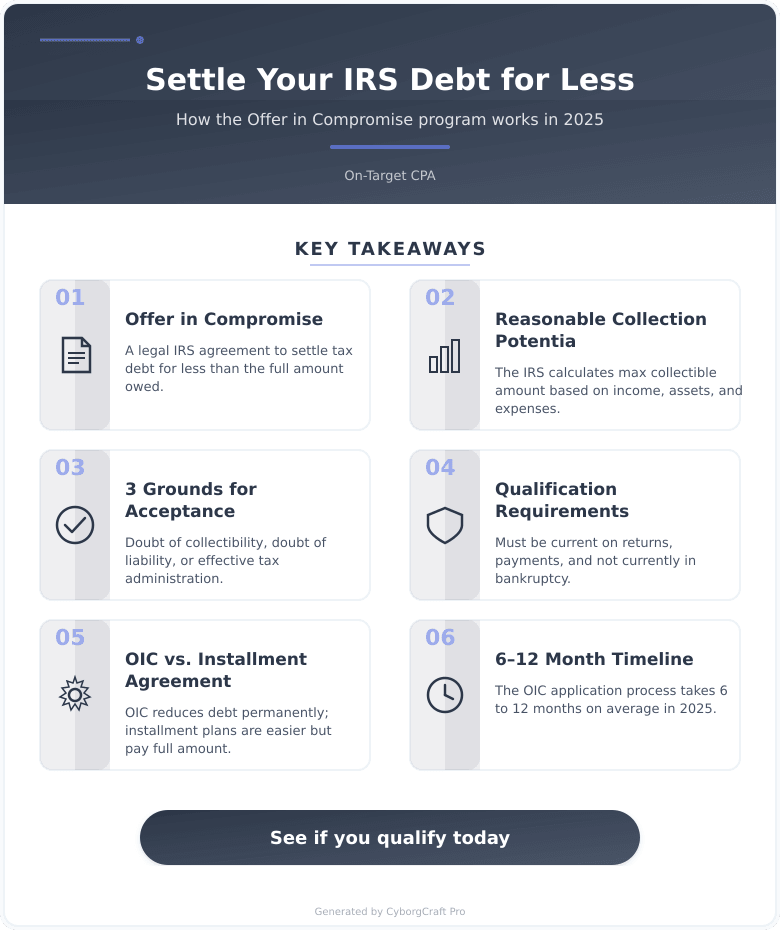
An Offer in Compromise is one of the few IRS programs that actually allows taxpayers to settle federal tax debt for less than the full amount owed. The key is understanding that the IRS accepts these offers based on a precise financial formula – your Reasonable Collection Potential – not simply because you are struggling. This post breaks down exactly how the program works in 2025, the three grounds for acceptance, and how an Offer in Compromise compares to alternatives like installment agreements and Currently Not Collectible status. Indiana taxpayers face state-specific IRS expense standards that affect how the agency calculates what you can pay, and those local numbers matter. The post walks through a complete seven-step action plan, a document checklist for applicants, and the most common mistakes that lead to rejection. A dedicated FAQ section covers costs (the 2025 application fee is $205), timelines (6 to 12 months), the appeal process, self-employment complications, and how Indiana’s own state tax settlement program operates separately from the federal one. The content is designed to help readers quickly assess whether they might qualify and what concrete steps to take next.