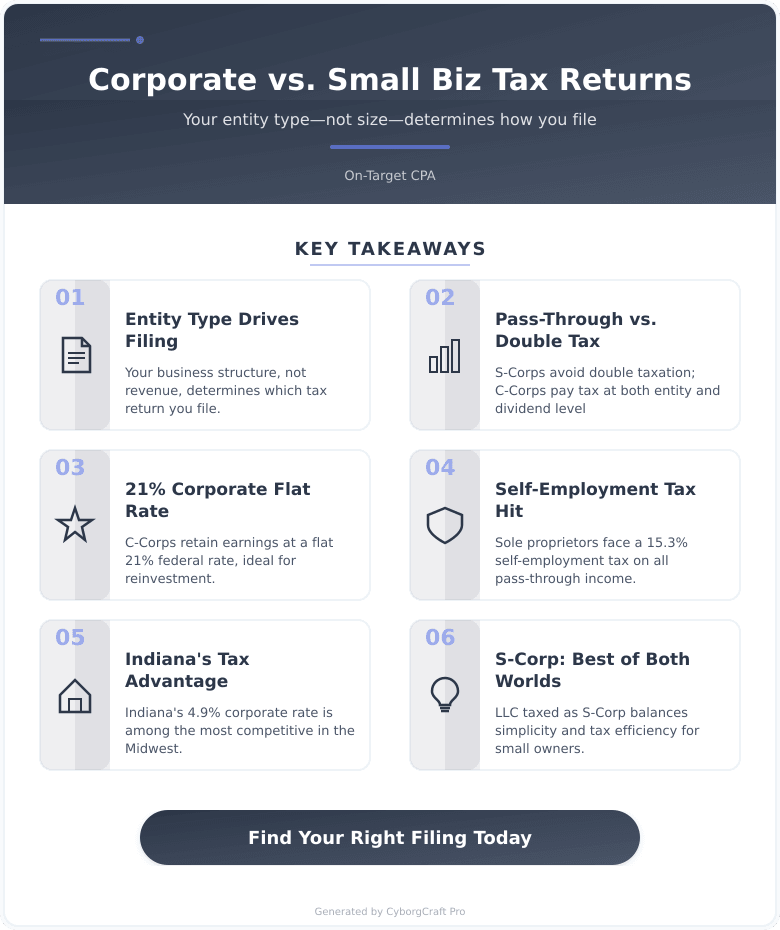
A corporate tax return is a formal filing submitted by a legally incorporated entity – such as a C-Corp or S-Corp – to report business income, deductions, and tax liability to the IRS. Understanding which return applies to your business structure can prevent penalties, reduce your tax burden, and keep you compliant under current 2025 rules.

This guide focuses specifically on helping Indiana business owners identify the right tax return type for their entity structure and avoid the most common filing errors.
Small Business Tax Return Definition: A small business tax return is a filing completed by sole proprietors, partnerships, LLCs, or S-Corps that passes business income through to the owner’s personal return, rather than taxing the entity separately.
Here’s the thing – a lot of business owners in Indianapolis get this wrong. They assume that because they run a “small” company, they automatically file as a small business. But your entity type, not your revenue size, determines what return you file. The most common mistake we see is an LLC owner filing the wrong form simply because they never confirmed their default tax classification with the IRS.
Corporate Tax Return vs Small Business Tax Return: Which Approach Works?
Where corporate tax returns succeed: They allow retained earnings to stay inside the company at a flat 21% federal rate (2025), enable certain fringe benefit deductions not available to pass-through owners, and create a clear legal separation between personal and business liability.
Where corporate tax returns fail: Double taxation applies to C-Corps – profits are taxed at the corporate level and again when distributed as dividends. Compliance costs are higher, and the paperwork burden is significant without a CPA.
Where small business returns succeed: Pass-through taxation means you only pay once. S-Corps and sole proprietors avoid the double-taxation problem entirely. Filing is often simpler for single-owner operations.
Where small business returns fail: Self-employment tax (15.3% in 2025) hits hard for sole proprietors. Pass-through income can push owners into higher personal tax brackets without proper planning.
The verdict: For most Indianapolis small businesses with one to five owners, a pass-through structure – whether an LLC taxed as an S-Corp or a straight S-Corp election – delivers the best balance of simplicity and tax efficiency. C-Corp status makes more sense if you plan to reinvest profits heavily or seek outside investors.
Thinking about this for your situation? Let’s talk. Contact us and we’ll walk you through your options – no pressure.
Breaking Down the Main Return Types
| Entity Type | IRS Form | Tax Treatment | Prep Cost |
|---|---|---|---|
| Sole Proprietor | Schedule C (1040) | Pass-through | Varies |
| Partnership | Form 1065 | Pass-through | Varies |
| S-Corporation | Form 1120-S | Pass-through | Varies |
| C-Corporation | Form 1120 | Entity-level (21%) | Varies |
| LLC (default) | Depends on election | Flexible | Varies |
According to the IRS, S-Corporations represent one of the most common corporate-style filings for small businesses. That reflects how many owners have found the S-Corp structure worth the added filing complexity.
Indiana-Specific Factors You Should Know
Indiana’s flat state income tax rate sits at 3.05% in 2025, down from prior years due to ongoing legislative reductions. That affects pass-through owners directly, since business income flows to their personal Indiana IT-40 return.
C-Corps in Indiana pay a separate state corporate income tax. As of 2025, that rate is 4.9% – one of the more competitive rates in the Midwest compared to Illinois (9.5%), Michigan (6%), Ohio (0% for most corps but with a gross receipts tax), and Kentucky (5%). For businesses evaluating where to incorporate, Indiana’s rate structure has genuine advantages.
Indiana also offers the Small Business Venture Capital (SBVC) credit, which can benefit investors in Indiana-based small businesses. Eligibility rules apply, so working with a CPA familiar with Indiana tax law matters here.
According to the Indiana Department of Revenue, businesses must also stay current on the Business Entity Report filed with the Secretary of State – a compliance step separate from your federal tax return that catches many owners off guard.
Your Tax Filing Action Plan
- Step 1 – Confirm Your Entity Type: Pull your IRS EIN letter or check your formation documents. This tells you exactly how the IRS sees your business.
- Step 2 – Verify Any Elections Made: Did you file Form 2553 to elect S-Corp status? Check before assuming your LLC is taxed as a partnership.
- Step 3 – Gather Required Documents: Collect income statements, expense records, payroll summaries, and prior-year returns before meeting your CPA.
- Step 4 – Check 2025 Deadlines: S-Corp and partnership returns are due March 17, 2025. C-Corp returns are due April 15, 2025. Personal returns with Schedule C follow the April 15 deadline.
- Step 5 – Review Indiana State Filing Separately: Federal and state filings are separate. Make sure your Indiana IT-20 (C-Corp) or IT-65 (partnership) is on the calendar too.
Documents You’ll Need Before Filing
- ☐ Profit and loss statement for the full tax year
- ☐ Bank statements and reconciled ledgers
- ☐ Payroll records and W-2s issued
- ☐ Records of assets purchased or sold
- ☐ Prior-year tax returns for reference
- ☐ Any IRS correspondence or notices received
- ☐ Your EIN and entity formation documents
See a complete overview of what our services cover to understand how we help clients prepare and file accurately.
Key Takeaways for Indiana Business Owners in 2025
- Entity type drives your form – not revenue, not number of employees
- S-Corps offer pass-through tax treatment with potential payroll tax savings when structured correctly
- Indiana’s 4.9% corporate rate is favorable compared to neighboring states, but still requires a separate state filing
- Deadlines differ by entity – partnerships and S-Corps face an earlier March deadline
- DIY filing carries real risk – small errors on corporate returns can trigger audits or missed deductions worth thousands
Frequently Asked Questions
What is the difference between a corporate tax return and a small business tax return?
A corporate tax return is filed by a legally incorporated C-Corp using Form 1120, while small business returns cover sole proprietors, partnerships, and S-Corps using pass-through forms. The main difference is whether the business entity itself pays tax or whether income flows to the owner’s personal return.
Does an LLC file a corporate or small business tax return?
An LLC’s filing type depends entirely on elections made with the IRS, not the LLC label itself. A single-member LLC defaults to Schedule C. A multi-member LLC defaults to Form 1065. Either can elect S-Corp or C-Corp treatment by filing the appropriate form.
What are the 2025 deadlines for business tax returns?
S-Corp and partnership returns are due March 17, 2025, while C-Corp and sole proprietor returns are due April 15, 2025. Extensions are available but do not extend the deadline to pay any taxes owed.
How much does it cost to file a corporate tax return in 2025?
Corporate tax return preparation costs vary depending on entity complexity. Simple S-Corps with clean books generally cost less than C-Corps with multiple shareholders or complex deductions, where preparation requirements are more involved.
Can a small business switch from a sole proprietorship to an S-Corp for tax purposes?
Yes, a business can elect S-Corp status by filing Form 2553 with the IRS, generally before March 15 of the tax year in which the election takes effect. This change can reduce self-employment tax for profitable businesses, but it also adds payroll compliance requirements.
What is the biggest mistake business owners make when filing their tax return?
The most common mistake is filing under the wrong form because the owner assumed their entity type without confirming their IRS classification. This leads to incorrect tax calculations, missed deductions, and potential penalties that a short conversation with a CPA could have prevented.
Does Indiana require a separate state tax return for businesses?
Yes, Indiana requires separate state filings for most business structures, including Form IT-20 for C-Corps and IT-65 for partnerships and S-Corps. These are filed with the Indiana Department of Revenue and follow their own deadlines and rules.
Your Next Step
Getting your business tax return right in 2025 is not just about avoiding penalties. It’s about making sure your entity structure actually works in your favor. Firms that take the time to review their classification and filing strategy before the deadline typically see meaningful savings and far fewer IRS headaches down the road.
At On-Target CPA, we work with business owners across Indianapolis and the surrounding area to make sure their filings are accurate, timely, and built around their actual financial situation – not just what’s easiest to plug into a software program.
Ready to take the next step? Contact us today for straight answers and real solutions. The filing deadline doesn’t move, but your options narrow the longer you wait.